
SUI tax rates can change from one year to the next, but the effect isn’t the same for every employer. State rules, experience rating, taxable wage bases, rate schedules, and unemployment claims can all play a role in determining unemployment tax costs. For employers operating in several states, the picture gets even more complicated because each state has its own requirements. Knowing what can change, how those changes affect payroll, and what to monitor can help employers plan for employer unemployment costs instead of dealing with unexpected expenses after the fact.
Why Are SUI Tax Rates Changing?
SUI tax rates can change because states use different unemployment tax systems and employers have different unemployment experiences. The U.S. Department of Labor explains that states use experience-rating systems to determine employer unemployment tax rates, although the specific methods differ by state.
Experience Rating Can Change an Employer’s Rate
Experience rating connects an employer’s unemployment history with its assigned SUI tax rate. In general, benefit payments charged to an employer can become part of its experience record and may affect future unemployment tax rates under the state’s system.
The exact calculation depends on state law. Not every unemployment insurance claim or benefit payment affects an employer’s account in the same way. Still, the basic connection matters: an employer’s unemployment experience can influence future unemployment tax costs.
State Taxable Wage Bases Can Change
The taxable wage base is the amount of an employee’s wages that is subject to SUI tax during the applicable period. When a state raises its taxable wage base, a larger portion of covered payroll may become subject to unemployment tax.
That can make a noticeable difference for employers with larger payrolls, even when the assigned unemployment tax rate stays unchanged.
State Rules and Rate Schedules Vary
There isn’t one nationwide SUI tax rate that applies to every employer. States establish their own rate schedules, taxable wage bases, experience-rating methods, and other unemployment tax requirements. These differences are also why SUI can vary significantly from one state to another.
That’s why multi-state employers can’t rely on one set of assumptions. A change affecting an employer in one state may have no effect on its workforce in another.
Key Factors That Can Change SUI Costs
Factor | What Employers Need to Know | Where to Watch for Changes |
Experience rating | An employer’s unemployment experience can affect its assigned rate | State experience-rating records |
Taxable wage base | Determines how much payroll is subject to SUI tax | State UI agency updates |
Rate schedule | States can use different rate structures and formulas | Annual state rate notices |
State UI updates | States may change unemployment tax requirements | State UI agency announcements |
How Do SUI Tax Rates Affect Employer Unemployment Costs?
An SUI tax rate applies to the portion of wages that is subject to state unemployment tax. When either the rate or taxable wage base changes, the employer’s unemployment tax liability can change too. The actual effect depends on the applicable state rules, the employer’s assigned rate, and the amount of taxable payroll. These factors can directly affect unemployment tax costs.
A Real Example of an SUI Tax Rate Change
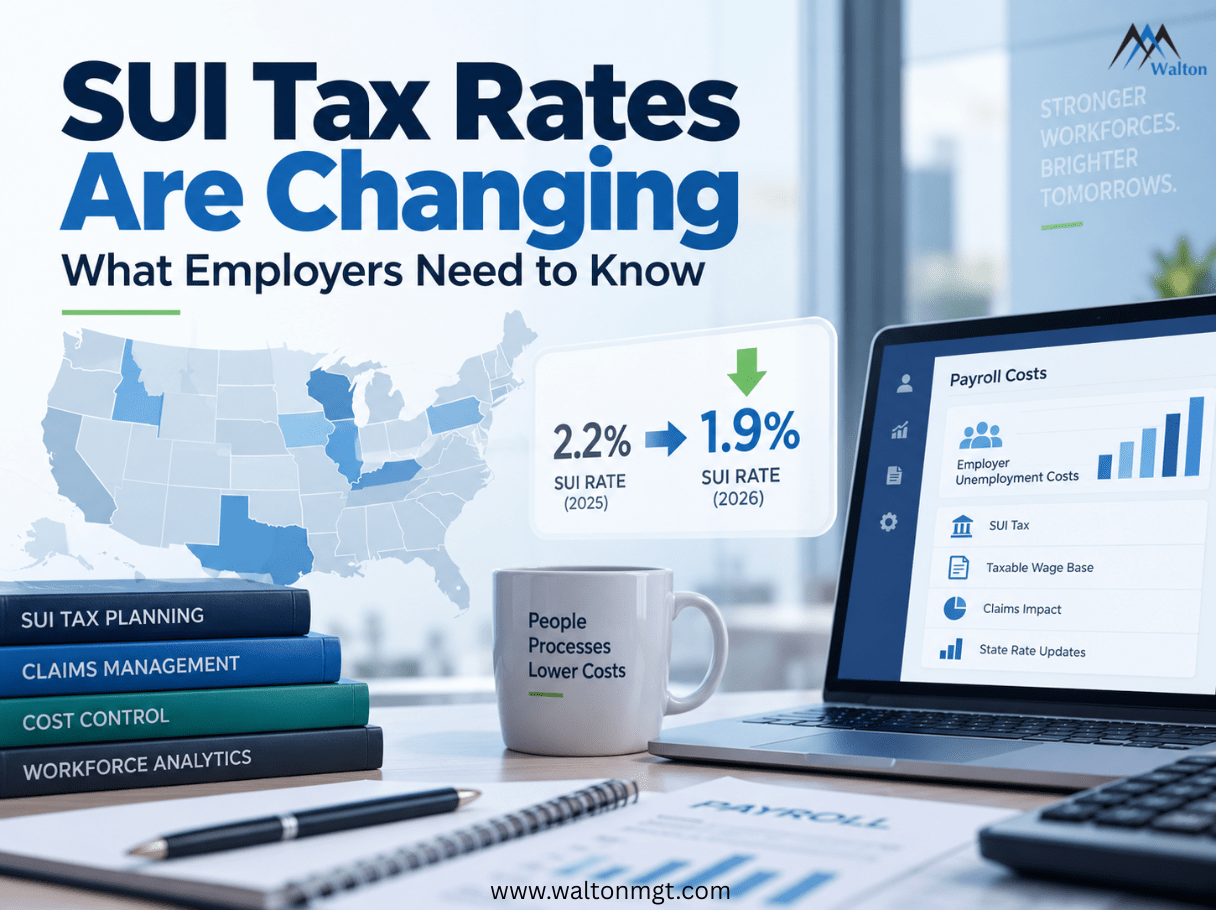
Connecticut’s 2026 changes show how a state can adjust both its taxable wage base and employer rates. For 2026, Connecticut increased its taxable wage base from $26,100 to $27,000, while its new-employer rate decreased from 2.2% to 1.9%. These changes took effect January 1, 2026.
A more recent example comes from Iowa. On September 2, 2026, Iowa Workforce Development announced that the state’s UI tax rates for 2027 will remain at the lowest possible level for the fifth consecutive year. The decision followed the annual review of Iowa’s Unemployment Insurance Trust Fund, which triggered Tax Table D for 2027.
Iowa’s 2027 taxable wage base will be $21,100, compared with $39,500 in 2025. The state also notes that its UI tax tables are influenced by the financial condition of the unemployment insurance trust fund.
These examples show why employers shouldn’t assume that an SUI tax rate change will always increase costs. Rate tables, taxable wage bases, experience rating, and state trust-fund conditions can all affect the amount employers pay.
How Can Unemployment Claims Affect Future SUI Costs?
Unemployment claims can have a financial effect beyond the immediate claim. Under experience-rating systems, benefit payments may be charged to an employer’s account, and those charges can influence future unemployment tax costs.
The U.S. Department of Labor explains that regular state unemployment insurance programs are financed through employer payroll taxes that are generally experience-rated. In these systems, benefit payments charged to employer accounts can contribute to higher future unemployment taxes. The specific rules and formulas vary by state.
That makes accurate information especially important. When an employee files an unemployment claim, employers may need to provide separation information and respond within the applicable state deadline. Employers should also review benefit-charge information and question potential errors through the process established by the state.
A claim may start as an HR task, but its financial impact can extend much further. Effective unemployment claims management can help employers stay organized throughout the process.
Walton’s Unemployment Claims Management service helps employers manage unemployment claims, respond to state requirements, and maintain better visibility into their unemployment insurance claims activity.
What Should Employers Review When Their SUI Rate Changes?
A new SUI rate notice shouldn’t simply be filed away. Reviewing the relevant unemployment tax forms and state notices can help payroll and tax teams confirm the information before the change flows into payroll.
Compare the New Rate With the Previous Rate
Check the old and new rates and confirm the effective date. This helps payroll teams determine which payroll periods could be affected.
Review the Employer’s Experience Record
Look at the claims and benefit charges included in the employer’s experience record. If something seems unexpected, compare it with internal records and supporting documentation.
Check the State’s Taxable Wage Base
Confirm the current taxable wage base for the applicable state. If it changed, determine whether a larger or smaller portion of payroll will be subject to the SUI tax.
Look for Incorrect Benefit Charges
Review charges associated with former employees and check the related separation information. If you find an error, follow the state’s process for disputing it and watch the applicable deadline.
Recalculate the Expected Payroll Impact
Once the rate and wage base are confirmed, update payroll projections. Make sure HR, payroll, and finance teams understand the potential effect on upcoming employer unemployment costs.
What Can Employers Do to Control Unemployment Costs?
Managing unemployment costs shouldn’t begin only after a new rate notice arrives. Strong processes throughout the year can give employers better visibility and make it easier to respond when unemployment tax rules or workforce conditions change.
Employers can:
- Build consistent claim processes: Create a clear workflow for handling unemployment insurance claims and supporting documentation.
- Keep separation records accurate: Make sure employment and separation information is complete and consistent.
- Assign ownership of state notices: Give a specific team responsibility for reviewing and responding to unemployment-related correspondence.
- Review claim activity throughout the year: Regular monitoring can make recurring issues easier to spot.
- Connect HR, payroll, and finance information: Bringing these data points together gives teams a clearer view of workforce activity and related costs.
- Plan ahead: Use unemployment tax planning and SUI tax planning to evaluate potential SUI tax changes, projections, and obligations.
- Use HR automation: Automate routine HR processes, employee records, and related workflows to improve accuracy, reduce manual work, and keep information organized for unemployment claims and tax planning.
Walton’s Unemployment Insurance Cost Control services bring unemployment claims management and tax planning together to help employers manage unemployment-related expenses.
The goal isn’t to react every time a state changes a rule. It’s to have a process that keeps unemployment costs visible throughout the year.
How Can Workforce Analytics Reveal Unemployment Cost Trends?
Not every unemployment-cost issue is obvious from a single claim or payroll report. Workforce analytics can give employers a broader view by connecting workforce activity across locations, departments, job categories, and other business areas.
Employers may use workforce analytics to identify:
- Locations with higher turnover.
- Departments experiencing recurring workforce changes.
- Job categories with unusual separation patterns.
- Differences in workforce trends across locations.
- Patterns that deserve closer attention during workforce-cost planning.
Walton’s Workforce Analytics service helps employers analyze workforce data and identify trends involving turnover, retention, and workforce activity.
The point isn’t to predict every future unemployment expense. It’s to give employers better information for workforce and cost planning.
How Should Employers Prepare for Future SUI Rate Changes?
A new SUI notice is easier to handle when employers already have a planning process in place. Instead of waiting for a rate change to create a payroll problem, businesses can make SUI tax planning part of their normal financial and workforce planning.
Employers should:
- Monitor state SUI updates and taxable wage-base changes.
- Keep employer account information current.
- Track state-specific unemployment tax requirements.
- Include known or potential unemployment costs in annual budgeting.
- Maintain separate tracking for states where the company has employees.
SUI Cost Planning Calendar
Timing | Planning Activity | Primary Team |
Monthly | Review unemployment claim activity and related trends | HR / Claims |
Quarterly | Compare unemployment costs with payroll and workforce data | HR / Finance |
Before annual budgeting | Factor known SUI changes into labor-cost projections | Finance / Payroll |
When state notices arrive | Review the rate, effective date, and account information | Payroll / Tax |
When state rules change | Assess potential operational or financial effects | HR / Tax |
Before rate-effective dates | Confirm payroll systems reflect applicable changes | Payroll |
A regular planning schedule gives employers a better chance of catching changes before they turn into last-minute payroll issues. For multi-state businesses, that discipline becomes even more useful because each state may have a different timeline and set of requirements.
How Walton Helps Employers Manage Unemployment Costs
Changing SUI tax rates can make unemployment costs harder to forecast, especially when an employer manages claims and payroll across several states. Walton offers services that address different parts of the problem.
- Unemployment Claims Management: Helps employers manage unemployment claims and related processes.
- Unemployment Tax Planning: Supports proactive planning around unemployment tax obligations and potential rate changes.
- Unemployment Insurance Cost Control: Brings claims management and tax planning together to help employers manage UI-related expenses.
- Workforce Analytics: Helps identify workforce patterns and trends that can support better cost planning.
If changing SUI rates are making unemployment costs harder to manage, Walton Management Automated HR Solutions can help you build a more proactive approach to claims, tax planning, cost control, and workforce analytics.
Conclusion: Prepare for Changing SUI Costs
SUI tax rates can change for several reasons, and the financial effect depends on the state, the employer, taxable payroll, and the rules that apply to the business. Employers that keep accurate records, monitor unemployment claims, track state updates, and plan for potential changes can better understand and prepare for their unemployment tax costs.
If you need help managing unemployment claims, planning for SUI tax changes, or controlling unemployment-related costs, contact www.waltonmgt.com to discuss how its HR solutions can support your business.
Frequently Asked Questions About SUI Tax Rates
SUI tax rates are state unemployment insurance tax rates employers pay on taxable wages. Each state sets its own rates and taxable wage base.
State governments establish and administer their unemployment insurance tax systems, including employer rates, taxable wage bases, and applicable requirements.
SUI tax rates can change because of experience rating, taxable wage bases, state rate schedules, and changes to state unemployment tax rules.
Yes. Under experience-rating systems, benefit payments charged to an employer may affect its unemployment experience and future SUI tax rate. Effective unemployment claims management can help employers stay on top of these processes.
No. States use different rate structures, taxable wage bases, experience-rating methods, and unemployment tax requirements. These differences are important when managing SUI across multiple states.
The timing varies by state. Employers should review their state's rate notices for the applicable rate year and effective date.
It can, depending on state law and applicable adjustments. Employers should check their state's unemployment agency for current requirements.
SUI refers to State Unemployment Insurance, while SUTA refers to the State Unemployment Tax Act. Both terms are commonly used when discussing state unemployment taxes.
Employers can focus on accurate separation records, timely claims responses, regular cost reviews, and proactive unemployment tax planning.
Workforce analytics can reveal patterns in turnover, separations, locations, and departments, giving employers useful insights for workforce and cost planning.
A taxable wage base is the amount of an employee's wages subject to state unemployment tax during the applicable period. Each state can set its own wage base.