
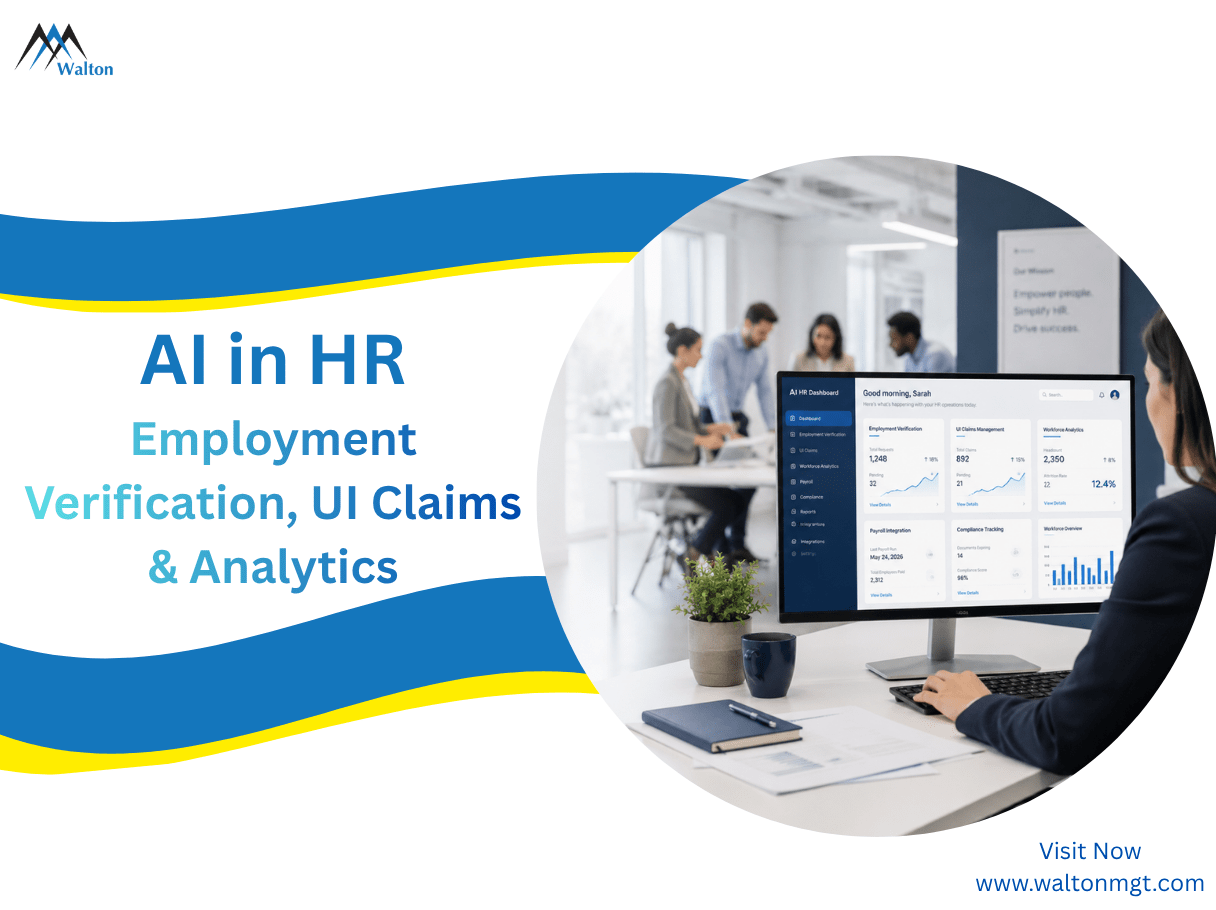
Human resources is becoming more complex as organizations face growing administrative demands, stricter compliance requirements, and higher expectations for delivering a seamless employee experience. As a result, AI in HR is helping businesses automate routine tasks, improve accuracy, and reduce manual workloads. From processing employment verification requests to managing UI claims and generating actionable workforce analytics, artificial intelligence in HR enables HR teams to work more efficiently while making faster, data-driven decisions.
Modern HR automation software and AI tools for HR bring these essential functions together through automated workflows, payroll integrations, and real-time reporting. Instead of relying on disconnected systems and time-consuming manual processes, organizations can streamline HR operations, strengthen compliance, and gain better visibility into workforce performance. In this guide, you’ll discover how AI is transforming employment verification, unemployment insurance claims management, and workforce analytics, along with the business benefits of adopting an integrated HR solution.
Why Is AI in HR Becoming Essential for Modern HR?
The role of HR has expanded significantly over the past decade. Beyond hiring and onboarding, HR teams are now responsible for maintaining compliance, supporting employees, managing workforce data, and responding to time-sensitive requests. Relying on manual processes to handle these responsibilities can slow operations, increase the risk of errors, and make it difficult to keep pace with changing business needs. That’s why more organizations are adopting AI in HR to automate repetitive tasks and improve overall efficiency.
Today’s HR automation software uses artificial intelligence in HR to streamline workflows, connect payroll and employee data, and provide real-time insights for better decision-making. Instead of spending valuable time on administrative work, HR professionals can focus on strategic initiatives such as employee engagement, workforce planning, and organizational growth. As businesses continue to embrace digital transformation, AI-powered HR solutions are becoming an essential investment rather than a competitive advantage.
Why businesses are investing in AI in HR
- Reduce repetitive administrative work and free HR teams for higher-value tasks.
- Improve accuracy across HR processes by minimizing manual errors.
- Deliver faster employee services, from employment verification to HR support requests.
- Strengthen compliance efforts through automated tracking and documentation.
- Make smarter workforce decisions with real-time data and predictive insights.
What HR Challenges Can AI Solve?
Despite advances in workplace technology, many HR departments still spend a significant amount of time on repetitive administrative tasks. Managing employee records, processing employment verification requests, handling UI claims, and compiling workforce reports often involve multiple systems and manual data entry. These disconnected processes can lead to delays, inconsistent information, compliance risks, and unnecessary pressure on HR teams. As organizations grow, these challenges become even more difficult to manage efficiently.
AI in HR helps address these issues by automating routine workflows, connecting data across HR systems, and providing timely insights for better decision-making. Instead of spending hours on paperwork and manual tracking, HR professionals can use AI tools for HR and modern HR automation software to streamline daily operations, improve data accuracy, and respond more quickly to employee and business needs.
Key HR challenges AI can solve include:
- Manual paperwork and repetitive administrative tasks
- Time-consuming employment verification processes
- Compliance risks caused by missing or inaccurate records
- Disconnected HR and payroll systems
- Delays in workforce reporting and data analysis
- Human errors from manual data entry and document management
How Does AI in HR Improve Employment Verification?
Employment verification is one of the most common yet time-consuming responsibilities for HR teams. Whether responding to requests from lenders, landlords, government agencies, or prospective employers, HR professionals often have to manually verify employment and income details while ensuring employee data remains secure. As request volumes grow, manual verification can create delays, increase administrative workload, and raise the risk of errors or inconsistent information.
AI in HR simplifies this process by automating employment verification workflows and connecting directly with payroll systems to retrieve accurate, up-to-date employee data. Instead of relying on phone calls, emails, or paper forms, organizations can use intelligent automation to process verification requests more quickly while maintaining security and compliance. This not only improves the experience for employees and third parties but also allows HR teams to spend less time on repetitive administrative work and more time on strategic initiatives.
Businesses that still rely on manual employment verification often face slower response times, higher administrative costs, and increased compliance challenges. Implementing an automated Verification of Employment and Income solution helps HR teams process requests faster, improve data accuracy, and provide a better experience for employees and third parties.
Traditional Employment Verification | AI-Powered Employment Verification |
Manual paperwork | Automated digital workflows |
Long response times | Faster verification requests |
HR handles every request | Self-service and automated processing |
Greater chance of errors | More accurate payroll data |
Limited availability | 24/7 access to verification services |
While automation speeds up employment verification, many organizations still struggle with outdated, manual processes. If you’re considering a more secure and efficient approach, our guide on When Is It Time to Transition From Manual VOE to a Centralized, Secure System? Explains the signs that it’s time to modernize your verification workflow.
How Does AI in HR Simplify Unemployment Insurance Claims?
Managing UI claims can be a complex and time-sensitive process for HR teams. Every claim requires accurate documentation, timely responses, and close attention to state-specific deadlines. When claims are handled manually, it’s easy to miss important dates, overlook supporting documents, or spend valuable time tracking claim statuses across multiple systems. These challenges can increase administrative costs and expose employers to unnecessary compliance risks.
With AI in HR, organizations can automate many aspects of unemployment insurance claims management, making the process faster, more accurate, and easier to oversee. Modern HR automation software centralizes claim information, tracks deadlines, organizes documentation, and helps HR teams respond promptly to claim requests. By reducing manual effort and improving visibility into every stage of the claims process, businesses can strengthen compliance while allowing HR professionals to focus on higher-value responsibilities.
Managing unemployment claims becomes much easier when employers use a dedicated Unemployment Claims Management solution alongside AI-powered HR automation. By centralizing claim tracking, documentation, and employer responses, organizations can reduce manual work, improve compliance, and respond to claims more efficiently.
How AI streamlines UI claims
- Tracks claim deadlines automatically to help employers meet required response times.
- Organizes supporting documentation in one secure location for easy access.
- Flags potentially fraudulent or suspicious claims for further review.
- Speeds up employer responses with automated workflows and notifications.
- Reduces manual processing by eliminating repetitive administrative tasks.
- Improves compliance through consistent recordkeeping and accurate reporting.
How Does AI in HR Improve Workforce Analytics?
Workforce data is one of the most valuable assets an organization has, but collecting data is only the first step. The real value comes from turning that information into meaningful insights that support better business decisions. Many HR teams still rely on spreadsheets or historical reports, making it difficult to identify trends, forecast workforce needs, or respond quickly to changing business demands. As a result, important issues such as rising turnover, increasing labor costs, or declining productivity may go unnoticed until they become larger problems.
AI in HR transforms workforce analytics by analyzing large volumes of employee and payroll data in real time. Using artificial intelligence in HR, businesses can identify workforce trends, monitor employee turnover and retention, evaluate hiring performance, forecast labor costs, and make data-driven decisions with greater confidence. Instead of reacting to past events, HR leaders gain actionable insights that help them plan for the future and improve overall workforce performance.
Workforce insights become even more valuable when they’re backed by accurate employee and payroll data. A dedicated Workforce Analytics solution helps HR teams monitor key metrics, identify trends, forecast workforce needs, and make more informed decisions with real-time reporting.
Without AI Workforce Analytics | With AI Workforce Analytics |
Historical reporting | Real-time insights |
Manual data analysis | Automated dashboards |
Reactive workforce planning | Predictive forecasting |
Limited visibility into trends | Actionable workforce insights |
Slower decision-making | Faster, data-driven decisions |
Organizations that use workforce data effectively can also improve the speed and accuracy of employment verification. Understanding the connection between analytics and verification helps HR teams make more informed decisions while reducing manual work. Learn more about using workforce data analytics for employment verification to streamline both processes.
Why Does One AI Platform Work Better Than Multiple HR Tools?
Many organizations rely on separate systems for payroll, employment verification, unemployment insurance claims, and workforce reporting. While each tool may serve a specific purpose, managing multiple platforms often leads to duplicate data entry, inconsistent records, disconnected workflows, and additional administrative work. Switching between systems can also make it harder for HR teams to maintain compliance and gain a complete view of their workforce.
Instead of juggling multiple systems, organizations can improve efficiency with Walton Management’s integrated HR automation solutions, which bring employment verification, UI claims management, workforce analytics, payroll data, and compliance into one centralized platform. By eliminating disconnected workflows and providing a single source of accurate HR data, Walton helps businesses simplify day-to-day HR management while improving visibility across their operations.
With one secure dashboard, connected workflows, and a unified payroll data source, AI in HR enables organizations to reduce manual effort, improve accuracy, and make faster, data-driven business decisions. HR professionals gain immediate access to the information they need, allowing them to work more efficiently while supporting compliance and long-term workforce planning.
What Business Benefits Does AI Bring to HR Teams?
Adopting AI in HR isn’t just about automating routine tasks. It’s about helping HR teams become more efficient, responsive, and strategic. By reducing manual processes and connecting critical HR functions through HR automation software, organizations can improve operational efficiency while giving HR professionals more time to focus on employee engagement, talent development, and long-term workforce planning. The result is a more agile HR department that supports both employees and overall business growth.
As AI tools for HR continue to evolve, businesses gain access to real-time insights that improve decision-making and strengthen compliance. From faster employment verification and streamlined UI claims management to advanced workforce analytics, AI helps organizations reduce administrative costs, improve accuracy, and deliver a better experience for both HR teams and employees.
Key business benefits
- Save time through automated HR workflows and fewer manual tasks.
- Reduce operational costs by improving efficiency across HR processes.
- Improve HR efficiency with connected systems and real-time data.
- Increase compliance confidence through accurate records and automated documentation.
- Support better workforce planning with actionable analytics and predictive insights.
What Should Employers Look for in AI HR Software?
Choosing the right HR automation software is about more than adding new technology. The best solutions should simplify everyday HR operations, integrate seamlessly with existing payroll systems, and support long-term business growth. As more organizations adopt artificial intelligence in HR, it’s important to select a platform that improves efficiency without creating additional complexity or requiring multiple disconnected tools.
When evaluating AI tools for HR, employers should prioritize solutions that automate essential HR functions while maintaining data security and regulatory compliance. Features such as employment verification, UI claims management, workforce analytics, and real-time reporting can help HR teams reduce administrative work, improve decision-making, and deliver better service across the organization.
Key features to look for include:
- Strong data security and employee privacy protections
- Seamless payroll integrations
- Automated employment verification and income verification
- Built-in UI claims management capabilities
- Advanced workforce analytics and reporting
- Scalable automation that grows with your business
- Reliable customer support and ongoing system updates
What Does the Future of AI in HR Look Like?
The future of AI in HR isn’t about replacing HR professionals. It’s about giving them better tools to make faster, smarter, and more informed decisions. As artificial intelligence in HR continues to evolve, organizations will rely more on automation to handle repetitive administrative tasks while HR teams focus on strategic priorities such as talent development, employee engagement, and workforce planning. This shift allows businesses to improve operational efficiency without losing the human element that remains essential to effective HR management.
Advancements in AI tools for HR will continue to enhance employment verification, unemployment insurance claims management, and workforce analytics through greater automation, predictive insights, and real-time reporting. Businesses that invest in modern HR automation software today will be better positioned to adapt to changing workforce demands, strengthen compliance, and build more efficient HR operations. As AI technology continues to advance, organizations that embrace integrated HR solutions will gain a lasting advantage in managing their workforce with confidence and agility.
Conclusion
As HR responsibilities continue to grow, businesses need smarter ways to manage critical processes without increasing administrative workloads. AI in HR is helping organizations streamline employment verification, simplify UI claims management, and turn workforce data into meaningful insights that support better decision-making. By replacing manual tasks with intelligent automation, companies can improve accuracy, strengthen compliance, and create a more efficient experience for both HR teams and employees.
At Walton Management, we help employers simplify HR operations through integrated solutions for Employment Verification, UI Claims Management, and Workforce Analytics. Our AI-powered HR platform brings these essential services together in one secure system, enabling organizations to automate routine tasks, improve compliance, reduce administrative burdens, and gain real-time workforce insights. Whether you’re looking to modernize employment verification, streamline unemployment claims, or make more informed workforce decisions, our team is here to help. Contact Walton Management today to discover how our HR solutions can streamline your operations, strengthen compliance, and support your organization’s long-term growth.
Frequently Asked Questions
AI in HR automates repetitive tasks such as employment verification, UI claims management, employee record management, and workforce analytics. It also helps HR teams improve compliance, reduce administrative work, and make better decisions through real-time data and predictive insights.
Yes. AI can automate employment verification by connecting with payroll systems to securely verify employment and income information. This reduces manual processing, improves accuracy, and speeds up responses for employees, lenders, landlords, and other authorized parties.
AI simplifies UI claims management by tracking deadlines, organizing documentation, automating workflows, and helping employers respond more quickly to claim requests. This reduces administrative effort while supporting compliance with state requirements.
Workforce analytics is the process of analyzing employee and payroll data to understand trends such as turnover, retention, hiring performance, labor costs, and productivity. AI enhances workforce analytics by providing real-time insights that support better workforce planning and business decisions.
No. AI is designed to support HR professionals, not replace them. By automating repetitive administrative tasks, HR teams can spend more time on strategic initiatives such as employee development, talent management, and organizational planning.
AI-powered HR automation helps businesses improve efficiency, reduce manual errors, strengthen compliance, speed up employment verification and UI claims processing, and gain valuable workforce insights. These benefits enable HR teams to deliver better employee experiences while supporting overall business growth.