

Venezuela’s government takeover of oil operations isn’t just another headline about nationalization. It’s actively reshaping how thousands of people work, get paid, and plan their futures in one of the world’s most oil-dependent economies.
When state control expands across an entire industry, the effects hit workers first. Jobs disappear overnight. Paychecks stop coming. And suddenly, unemployment insurance claims flood a system that wasn’t ready for the volume.
Oil sector employees, from engineers to contractors, are watching their employment stability collapse in real time. Foreign companies are pulling out. Hiring freezes are spreading. Workers who spent decades in oil suddenly find themselves navigating UI claims and searching for jobs in an industry that’s fundamentally changed.
Let’s break down exactly what’s happening to jobs, why unemployment claims management became critical overnight, and what the employment landscape actually looks like after state control takes over.
What Venezuela’s takeover actually means on the ground
Venezuela’s oil sector takeover quickly altered how jobs were structured and managed.
State control replaced private hiring systems, reducing roles and increasing uncertainty.
For workers, the impact felt sudden as long-standing positions disappeared almost overnight.
How state control changed everything overnight
State control over Venezuela’s oil sector didn’t happen all at once, but the employment impact sure felt that way for workers.
When the government expands its grip on oil operations, it’s not just changing who signs the paychecks. It’s rewriting hiring policies, restructuring entire departments, and deciding which roles stay and which ones get cut. For thousands of employees, that meant walking into work one day and finding out their jobs no longer existed under the new structure.
The takeover changed everything about how oil companies operated. Private sector hiring practices got replaced with government protocols. Performance metrics shifted. Reporting structures got flipped. And workers who’d spent years mastering their roles suddenly had to prove their value all over again to new managers with different priorities.
Foreign companies leaving meant jobs disappearing
Here’s what actually happened in those first months.
Foreign oil companies that had been operating in Venezuela for decades started pulling back operations. Some left entirely. Others dramatically reduced their presence. When those companies exited, they didn’t just take their investment dollars with them. They took jobs. Lots of jobs.
State-run entities stepped in to absorb some workers, but not nearly enough. The government’s oil company, PDVSA, took control of facilities previously managed by international firms. But state operations didn’t need the same workforce size. Efficiency wasn’t the priority anymore. Political loyalty often mattered more than technical skill when deciding who kept their job.
When UI claims overwhelm the system
The unemployment insurance claims started piling up almost immediately. Workers who’d never filed for UI claims in their lives suddenly found themselves navigating a system they didn’t understand. And the volume overwhelmed Venezuela’s unemployment claims management infrastructure, which wasn’t built to handle industry-wide collapse.
Contractors got hit even harder than direct employees. When oil companies reduced operations, contract work vanished first. These workers often had less protection, fewer benefits, and almost no warning before their projects got canceled. Many didn’t even qualify for standard unemployment insurance claims because of how their contracts were structured.
The workforce solutions that existed before the takeover couldn’t scale to meet this level of disruption. Support systems designed for normal turnover rates completely failed when facing mass displacement across an entire sector.
The unemployment insurance claims explosion
The unemployment insurance claims didn’t just increase. They exploded.
Workers who’d been employed for decades in stable oil jobs suddenly found themselves filing UI claims for the first time. Venezuela’s unemployment claims management infrastructure wasn’t built for this. The system handled maybe a few hundred monthly claims from the oil sector under normal conditions. After the takeover? Thousands hit the system within weeks.
What actually happened: Processing backlogs stretched for months. Workers who filed unemployment insurance claims in January were still waiting for responses in June. The delay wasn’t just frustrating; it was financially devastating for families who’d lost their primary income source.
The ripple effect multiplied the damage. When oil workers lost jobs and stopped spending locally, restaurants closed. Retail shops cut hours. Service businesses laid off their own staff. Each job loss in oil triggered 2-3 more UI claims in related industries.
Contractor chaos made everything worse. Support staff, cafeteria workers, and security personnel all worked through third-party companies. Their unemployment claims management got even messier because of complicated employment structures. Many didn’t qualify for standard benefits despite losing oil sector income.
The system couldn’t adapt fast enough: Emergency processing centers opened but lacked trained staff. Digital filing systems launched, but required internet access that most workers didn’t have reliably. Every solution introduced new barriers. The UI claims backlog eventually grew so massive that workers started giving up on the system entirely.
How state control destroyed payroll systems
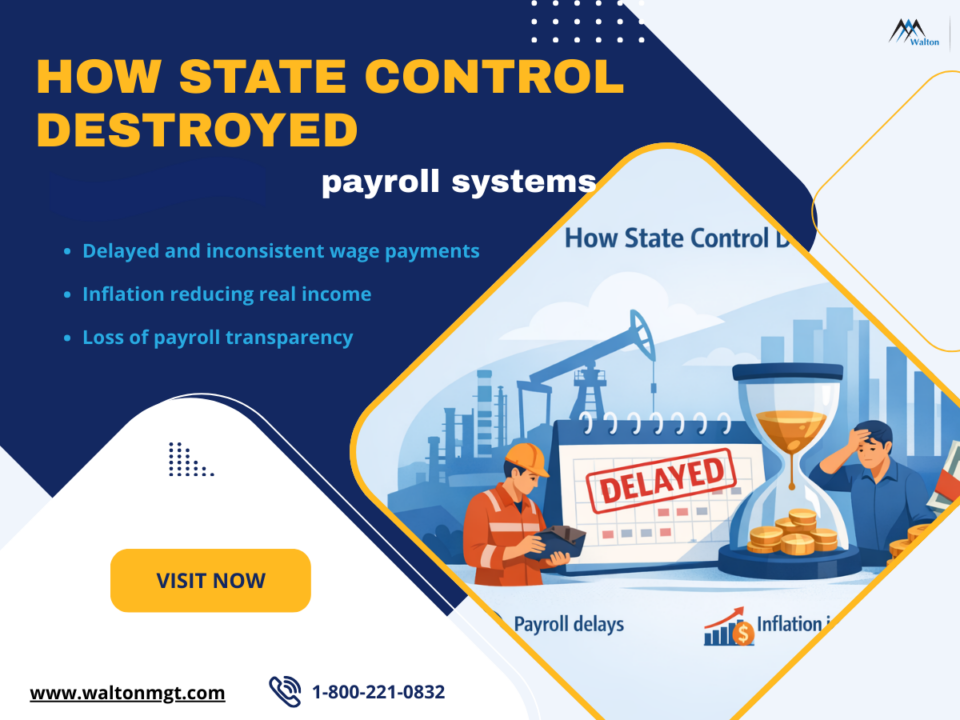
State control didn’t just change who ran Venezuela’s oil operations. It fundamentally broke how workers actually got paid. The transition from private company payroll management to government-controlled processes created chaos that affected everyone from senior engineers to entry-level staff. Workers who’d received consistent paychecks for years suddenly faced uncertainty every pay period.
The payment breakdown
Delays became the new normal
Workers waited weeks, sometimes months, for wages that should have arrived bi-weekly. The gap between private and state payroll management systems meant nobody took clear responsibility for processing payments during the transition.
Currency collapse ate paychecks alive
Even when money finally arrived, Venezuela’s inflation crisis had already destroyed its value. A month’s salary paid 30 days late might only cover half of what it originally would have. Workers weren’t just dealing with delayed payment; they were watching their earnings become worthless in real time.
Every facility operated differently.
One oil site might pay workers on time while another location, just miles away, runs two months behind. The lack of standardized payroll management under state control meant each facility operated independently, creating massive inconsistency across the workforce.
What disappeared in the chaos
Benefits stopped being processed
Health insurance premiums weren’t forwarded correctly. Retirement contributions vanished into bureaucratic black holes. Workers discovered months later that deductions had been taken, but never actually reached the right accounts.
System transparency went to zero
Private companies offered digital portals where employees could check pay stubs and verify deductions. State systems relied on paper processes that were inconsistent and nearly impossible to navigate. Workers had no way to confirm what they were owed versus what they received.
The payroll breakdown directly accelerated brain drain. Skilled workers, the engineers and technicians Venezuela’s oil sector desperately needed, left for jobs in other countries where reliable payment was guaranteed. When you can’t promise employees they’ll actually get paid on time, workforce solutions for retention become meaningless.
Current employment landscape: who’s hiring, what jobs exist now
The employment picture in Venezuela’s oil sector looks nothing like it did before state control took over. Understanding what jobs actually exist now versus what disappeared helps clarify the real workforce impact.
State entities absorbed some roles, but selectively
PDVSA, Venezuela’s government oil company, took control of facilities previously run by foreign firms. They hired some displaced workers but prioritized political loyalty over technical expertise in many cases. Engineers with decades of experience found themselves passed over for positions given to candidates with the right government connections.
Private sector opportunities vanished almost completely
International oil companies that once provided stable, well-paying jobs either left Venezuela or reduced their presence to a bare minimum of operations. The private sector jobs that remain operate under constant uncertainty, with companies hesitant to expand hiring when government policies can change overnight.
Contract work dried up across the board
Before the takeover, contractors provided essential services across Venezuela’s oil infrastructure. Maintenance crews, logistics coordinators, and technical consultants all found steady work. Now? Contract opportunities dropped by an estimated 70%, and the remaining positions pay significantly less than pre-takeover rates.
Skill requirements shifted toward compliance over capability
Jobs that still exist increasingly prioritize workers who can navigate bureaucratic systems and government protocols over those with exceptional technical skills. Understanding state paperwork matters more than understanding oil extraction in many current roles. This shift has frustrated experienced professionals who built careers on technical excellence.
Remote and international positions became the real growth area
The only employment growth in Venezuela’s oil sector is due to workers leaving to take jobs elsewhere. Skilled employees now work remotely for international companies relocated entirely to countries with stable oil industries. These workers still contribute their expertise to oil operations, just not within Venezuela’s borders.
The current landscape offers limited prospects for anyone trying to build or maintain a career in Venezuela’s oil sector. Workforce solutions that address this reality remain scarce, leaving workers to figure out their own paths forward.
Managing workforce disruption: what actually works
When an entire industry collapses, standard workforce management strategies fail. Venezuela’s oil sector showed what actually helps when employment chaos hits at scale.
Helping workers file unemployment insurance claims fast
Companies that handled layoffs well didn’t just hand out termination letters. They set up support teams specifically to guide displaced workers through UI claims processing. This reduced legal disputes and helped former employees access unemployment insurance claims benefits faster. Simple resources made the difference: step-by-step filing guides, government office contacts, and claim form templates that workers could actually use.
Keeping payroll running despite the chaos
Operations that survived adapted their payroll management immediately. Some switched to weekly payments instead of monthly to help workers deal with the currency collapse. Others offered partial foreign currency compensation or provided goods directly when cash became unreliable. Not perfect solutions, but they kept critical employees from leaving.
Training workers for jobs outside oil
The best workforce solutions didn’t try to keep people in a dying industry. They prepared workers for what came next. Skills training that made oil experience transferable. Resume help that reframed technical expertise for international employers. Language courses that opened doors to remote positions with foreign companies. Programs that invested here saw workers transition successfully instead of staying unemployed indefinitely.
Cross-training to survive the brain drain
Companies still operating have learned to train employees across multiple roles. When you can’t hire or replace workers reliably, having people who understand several functions becomes essential. This workforce management approach overworked already stressed staff, but it kept operations going when specialists left.
Saving knowledge before it walked out the door
Smart organizations documented everything before experienced workers departed. Process manuals, training videos, and mentorship between senior and junior staff. When brain drain accelerated, companies with documentation could still function. Those without it couldn’t perform basic operations.
Most workforce solutions during Venezuela’s crisis were reactive scrambles, not careful planning. But what worked, however imperfectly, offers real lessons for industries facing disruption.
The ripple effect: contractors, suppliers, and related industries
Venezuela’s oil sector takeover didn’t just hurt direct employees. The damage spread far beyond oil rigs and refineries into every business connected to the industry.
Who got hit and how hard:
| Industry Sector | Impact | Employment Effect |
|---|---|---|
| Contractors | Maintenance, security, and transportation contracts were canceled overnight | First wave of UI claims from workers with complicated employment structures |
| Supply Chain | Industrial parts, office supplies, and catering services lost 60–70% of customers | Businesses couldn't survive on remaining demand, triggering mass layoffs |
| Local Services | Restaurants, shops, and mechanics in oil towns lost their customer base | Secondary unemployment wave as oil workers stopped spending locally |
| Professional Services | Legal, accounting, and consulting firms serving oil companies saw a client loss | Skilled workers filed unemployment insurance claims or left Venezuela entirely |
Contractors and suppliers felt the collapse immediately. Their unemployment insurance claims paperwork was more complicated than direct employees, and many fell through system gaps entirely. Workforce solutions for these indirectly affected workers barely existed, with government programs focusing only on direct oil sector employees.
The total employment impact likely exceeded direct oil sector job losses by two or three times. For every oil worker who filed UI claims, at least two more people in connected industries lost their income as well.
Long-term outlook: what employment looks like going forward
The future of employment in Venezuela’s oil sector doesn’t look promising, and pretending otherwise does nobody any favors.
Production decline means fewer jobs, period
Venezuela’s oil production has dropped dramatically under state control. The country that once produced over 3 million barrels per day now struggles to maintain even 700,000. Lower production requires fewer workers. Simple math that translates to permanently reduced employment capacity across the sector.
Skills mismatch will take years to fix
The brain drain already happened. Experienced engineers, geologists, and technical specialists left for jobs in other countries. Replacing that expertise takes decades, not years. Even if Venezuela’s oil sector stabilizes, rebuilding a skilled workforce capable of modern operations requires long-term investment in training and education that isn’t happening right now.
State control prioritizes politics over efficiency
Employment decisions under government control often favor political loyalty over technical capability. This approach doesn’t build a competitive industry or create stable, skilled jobs. It creates positions filled based on connections rather than competence, which undermines long-term sector viability.
The realistic long-term outlook means workers currently in Venezuela’s oil sector should prepare for continued instability. Job security remains low. Wage growth stays negative when adjusted for inflation. Workforce solutions that help people transition out of oil entirely make more sense than strategies aimed at building careers within a declining sector.
What workforce management professionals can learn from this
Venezuela’s oil sector collapse offers hard lessons for HR teams and workforce managers everywhere. This isn’t just about one country’s industry failure. It’s about recognizing warning signs and preparing for disruption before it destroys your workforce.
| Key Lesson | What It Means | Action Required |
|---|---|---|
| Industry concentration risk | Entire economies that depend on a single sector multiply employment vulnerability | Diversify employee skills across multiple industries for better stability |
| Claims system stress testing | Most UI claims systems collapse under crisis pressure | Test whether the unemployment insurance claims infrastructure can handle mass displacement |
| Payroll flexibility | Rigid payment structures break when currency or systems fail | Build backup payment methods and alternative compensation strategies now |
| Political risk in workforce planning | Government policy changes can eliminate jobs overnight | Include political stability metrics in workforce analytics and planning |
When currency collapses or payment systems fail, companies need alternatives ready. Organizations that survived Venezuela’s chaos had backup payment methods. Alternative compensation strategies, multiple currency options, and creative benefit structures kept critical employees from leaving immediately.
The brain drain that devastated Venezuela’s oil sector removed decades of accumulated expertise. Companies that documented processes, cross-trained employees, and captured knowledge in transferable formats maintained operational capability. Those who didn’t lose critical skills permanently.
Every workforce solution implemented during Venezuela’s collapse was reactive. Nobody prepared for the scale of disruption before it hit. Smart workforce management means identifying risks early and building response strategies before crisis forces improvisation.
Being prepared means having unemployment claims management protocols ready, payroll management alternatives tested, and workforce solutions designed for worst-case scenarios, not just business as usual.
Conclusion
Venezuela’s oil sector takeover destroyed more than production numbers. It eliminated careers, displaced tens of thousands of workers, and overwhelmed unemployment insurance claims systems that weren’t built for industry-wide collapse. Workers face delayed paychecks, complicated UI claims processes, and shrinking job opportunities while companies struggle with payroll management chaos and lose their most skilled employees to brain drain.
For workforce management professionals, this situation highlights what happens when systems designed for normal conditions face extraordinary stress. Understanding these dynamics helps organizations prepare better to test their unemployment claims management infrastructure under stress scenarios, build payroll management flexibility before they need it, and develop workforce solutions that address rapid disruption, not just gradual change.
At Walton Management, we help companies build workforce strategies that withstand disruption. Whether you’re managing unemployment insurance claims during layoffs, adapting payroll systems for changing conditions, or developing comprehensive workforce solutions for uncertain times, having experienced partners makes the difference between chaos and controlled transition. The employment landscape keeps changing, and being ready matters more than ever. Contact us today to discuss your workforce challenges and learn how our team can support a stable, well-planned transition.